Business model innovation
The business model innovation process in small and midsize companies.
How SMEs can establish business model innovation as a recurring process.
March 7, 2024 · 5 min read
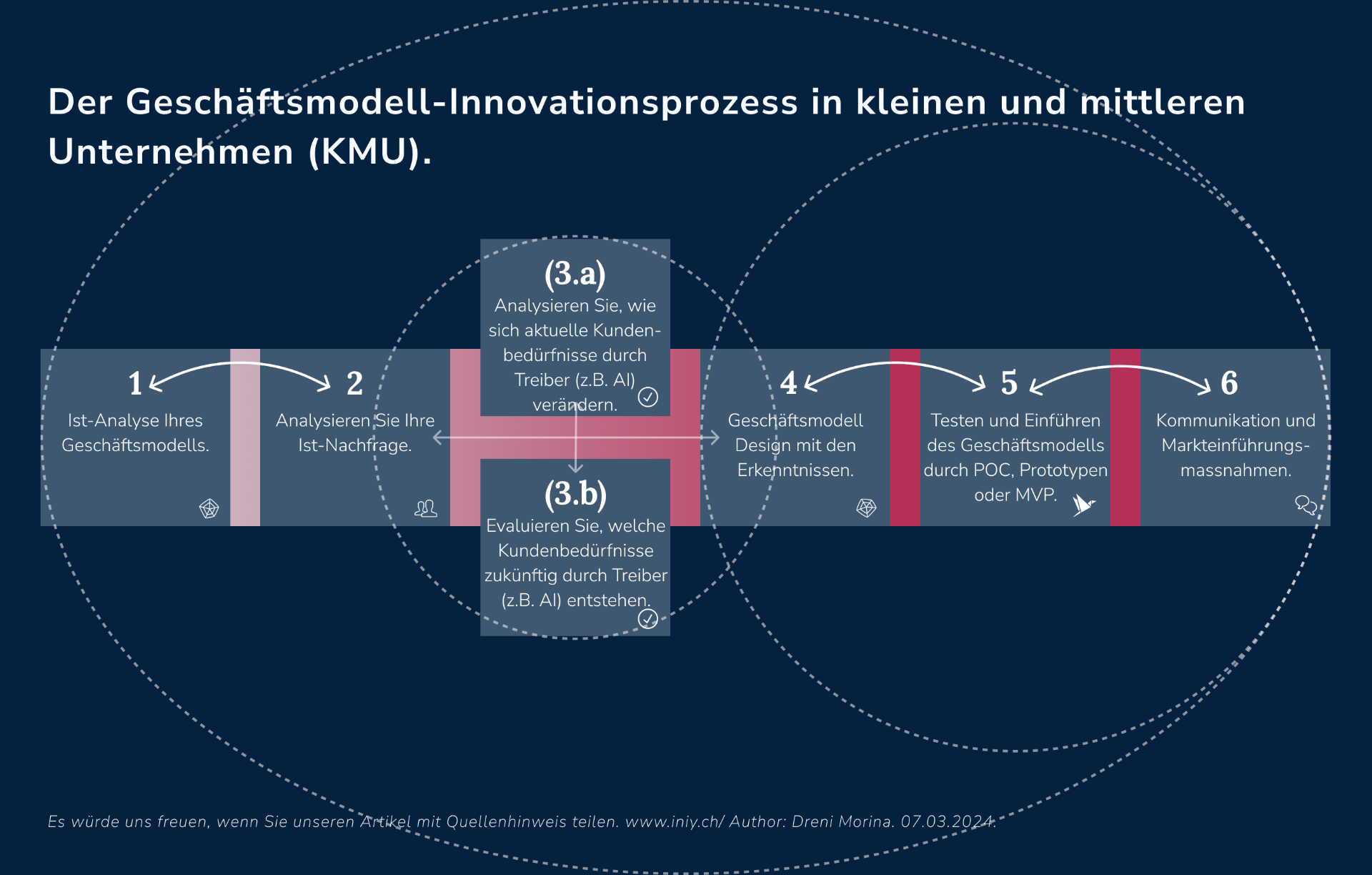
Our previous article examined the short- and long-term impact of AI and how that impact differs by a company’s technology status. This article explores how small and midsize companies can implement business model innovation as a recurring process. Every stage should operate as an iterative feedback loop, and business model innovation should be treated as an ongoing management discipline.
For a consultancy focused on business model innovation, AI is both a challenge and an important shift because many functions and processes change at once. Complexity and strategic uncertainty are high. Companies often adapt incrementally and unconsciously while daily attention remains on operations. That focus can produce lean processes and quality products, but it can also cause leaders to neglect the business model. Research and practice show that neglecting strategic development is a business risk. Long-term development requires resources, deliberate risk-taking, integration with business strategy, and structured execution. Our guide combines established models and approaches for that purpose.
1. Start with a current-state analysis.
Analyze all internal and external business factors. Review the sales model, marketing plan, product and service portfolio, processes, and organizational structure. The goal is to understand historical performance and current positioning precisely. Even when a business model has evolved organically, strategic direction requires a current, objective representation of how it works.
2. Analyze current demand.
Focus next on current demand. Who buys your products and services? How should performance be evaluated in the company and market context? Where are your competitive advantages and core capabilities? A detailed view of sales volume, customer groups, dependencies, financial risks, geography, and demographics reveals opportunities and risks that are essential to strategic, financial, and organizational development.
3a. Evaluate which customer needs are changing now because of market drivers such as AI.
After documenting performance and processes, examine opportunities created by current market changes. Combine internal analysis with external market data and derive high-quality insights. Compare the findings with ready-to-use opportunities such as AI solutions. Implementation often creates incremental changes to one or more business models. The same approach applies to regulatory, economic, and other market drivers.
3b. Evaluate which future customer needs will emerge from market drivers such as AI.
Current demand is only one part of business model innovation, which must also anticipate future change and align the model accordingly. Both perspectives matter, and current demand may be closely connected to future demand depending on the proximity of the new product or market. Use the available evidence to derive long-term demand shifts relevant to forward-looking innovation.
Looking only at current demand is risky because demand for specific products often declines over their life cycles. Beyond a critical point, companies may lack the resources to change, while barriers to new markets and competing business models may already be too high. Startups frequently pressure established leaders with innovative models and new markets—what is commonly called disruption. Resistance to change may also increase as performance deteriorates. Even primary-sector businesses with relatively stable demand can face long-term decline.
Demand for timber provides a simplified example. Innovative materials and environmental regulations can threaten the long-term model of wood processors. Companies must diversify and include more innovative substitutes, which is likely to change the long-term model and requires strategic planning. Across industries, technological progress lowers the production cost of physical and digital innovations. In AI, falling computing costs can make previously unprofitable applications viable, so companies need to act, learn, and build long-term models.
4. Design the business model from the insights.
Consider current and future market needs together and design the new business model or models. Companies do not need to abandon the existing model abruptly. A business with multiple successful units can introduce a model for future demand in parallel and allocate strategic and operating resources deliberately. Every innovation is individual, though digital elements often become more prominent. This staged approach can keep investment risk comparatively low.
5. Develop the business model.
A phased implementation is often appropriate depending on how the current and future models change and which resources are affected. Digital changes can begin with a prototype, proof of concept, or minimum viable product. We can support planning, concept development, and design, while technical development can be completed with your team or experienced partners.
For models that are not digitally transformed, adapt the relevant operating processes. Identify potential sources of error early and develop mitigation strategies alongside the model. Change operations step by step to continue meeting existing customer needs while introducing new processes with appropriate quality.
6. Communicate and implement the business model.
Communicate transparently before and during implementation, whether changing an existing model or creating a new one inside the organization. Natural resistance depends on the scale of change and how well employees were involved in earlier stages. Clear communication from the beginning helps explain the long-term benefits for the company and its people.
We are a large company. What changes for us?
The process is similar in large companies, but complexity and organizational barriers are higher. Matrix structures, hierarchy, and strong process or product ownership can make end-to-end decisions difficult. Conflicting goals and incentives can reduce strategic flexibility. Leaders must explicitly address and minimize these risks.
Business model innovation differs from incremental product innovation, where individual units can operate more independently. Leadership must build a culture in which models can be developed and redesigned with low barriers. Cross-functional teams or dedicated units can help, but may struggle with organizational change and access to implicit knowledge. Large companies therefore need well-resourced collaboration to address both organizational and methodological requirements.
Conclusion
This guide is designed to help your company assess its business situation comprehensively and identify potential changes. Applying it can help you realize the organization’s full potential and prepare for future challenges.
Abbreviations
- AI – Artificial Intelligence
- POC – Proof of Concept
- MVP – Minimal Viable Product
- SME – Small and midsize enterprise
Have questions about this topic?
We would be happy to advise you personally on your specific challenges.
Schedule a consultation