AI strategy
Strategic archetypes in the age of AI: An analysis of the impact on business models
How AI influences business models and which factors determine long-term competitiveness.
December 22, 2024 · 5 min read
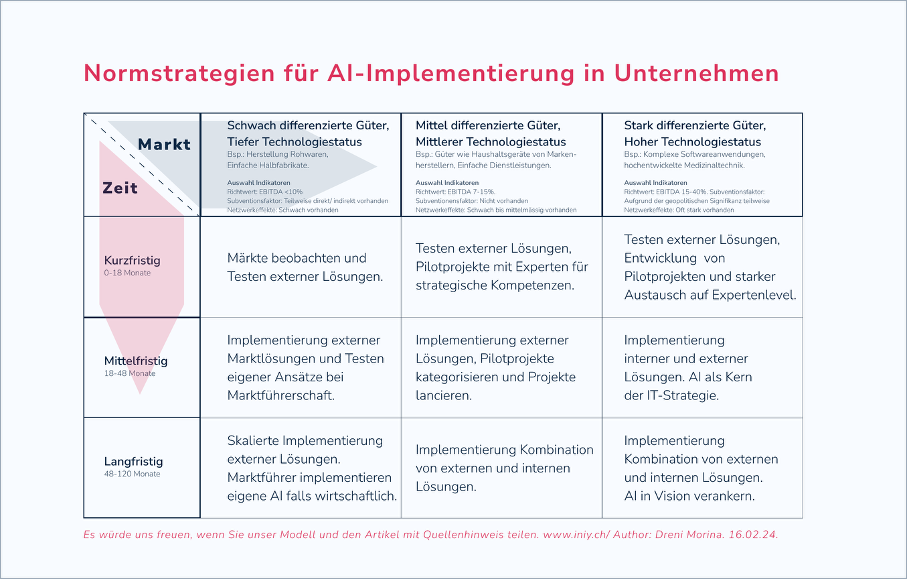
Read our analysis of artificial intelligence (AI) and its impact on business models. We believe AI will significantly affect business models and the long-term competitiveness of many companies. In the medium to long term, virtually every business function will be directly affected. Two decisive factors are time and the differences among companies based on their technology status.
Technology status as a combination of capability and willingness to adopt
Technology status is not a standardized term. In a business context, we divide it into two main factors. The first is technology capability: how well a company can implement and use new technologies. The second is willingness to adopt: how readily the company adapts in a changing technology environment. The factors constrain each other. Sustainable benefits from AI require a balanced minimum level of both, influenced by company culture, financial capacity, and business strategy.
Optimizing and creating functionality
Economically, AI can provide optimizing or creating functionality. Optimizing applications improve productivity, much like continuous improvement, Six Sigma, or Kaizen. These advances matter, but often do not fundamentally alter the business model because their effect on its overall structure is limited. Higher productivity or customer satisfaction can stabilize performance during inflation or labor shortages, but incremental improvements alone rarely create lasting competitive advantage.
Perfectly competitive markets and the impact of AI
AI will have a strong absolute impact in perfectly competitive markets, but the standardized nature of the offering makes durable AI-based advantages unlikely. Companies will focus on productivity and process innovation to maintain competitiveness, with AI lowering production costs over time. International trade adds a dynamic dimension: advanced economies may use AI and scale effects to gain share in homogeneous goods, while AI also influences tax, trade, and subsidy policy.
Technology-intensive companies and critical factors
AI is considerably more important for technology-intensive companies and becomes a critical long-term factor. Without suitable strategies and action, differentiated technology businesses may lose competitiveness. They must identify AI-driven market changes early, make AI part of the company vision, and commit sufficient resources. Rapid innovation and product life cycles require a focus on changing customer needs, new services, new markets, and the timing of technological opportunities.
Time horizon and technology adoption
A strategic archetype needs a time dimension because AI’s potential changes over time. This helps companies assess the dynamic, growing impact on their business models and act proactively. The model supports an initial assessment of the status quo and incorporates technology-adoption patterns. AI’s near-term economic impact may be overstated, while its long-term growth opportunities are underestimated. We use shorter cycles to reflect faster change; roughly five years may already represent a long-term horizon. Stages can overlap, and a suitable AI strategy must also consider company-specific internal and external factors.
In the next article, we will explore the topics that emerged from this analysis in greater depth. We look forward to continuing the discussion!
Have questions about this topic?
We would be happy to advise you personally on your specific challenges.
Schedule a consultation